Colfax County Dog Registration Information
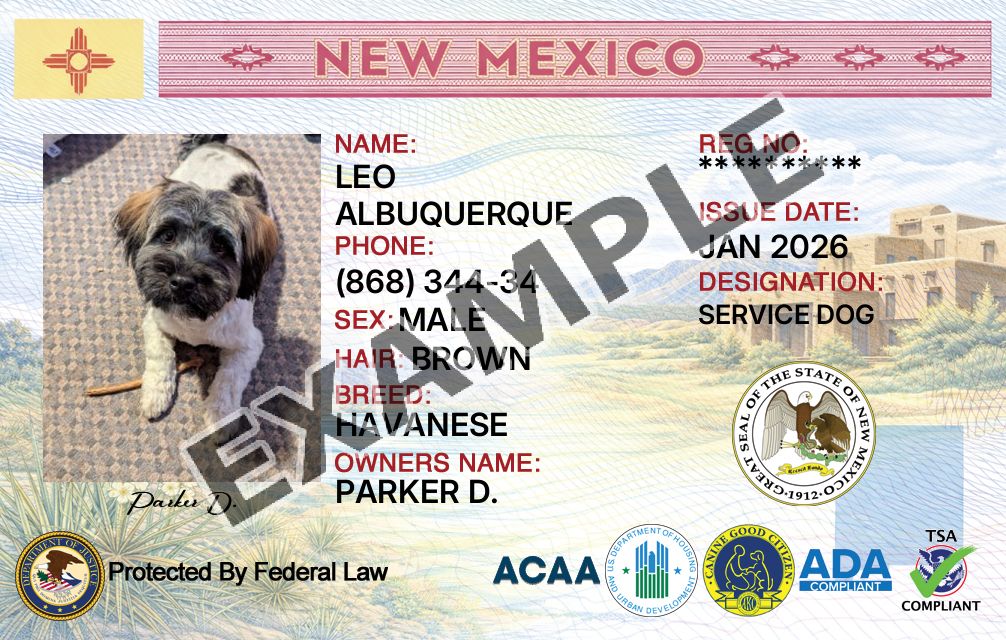
Service Dogs and Emotional Support Animals in Colfax, New Mexico
Registering a Dog in Colfax County, New Mexico (Including Service Dogs and ESAs)
If you’re asking, “where do I register my dog in Colfax County, New Mexico for my service dog or emotional support dog”, the key thing to know is that dog licensing is usually handled locally—most often by the city or village where you live (and sometimes by county law enforcement for unincorporated areas). A dog license in Colfax County, New Mexico is generally about public health and animal control (especially rabies vaccination verification), while service dog and emotional support animal status are legal designations governed by different rules.
Where to Register or License Your Dog in Colfax County, New Mexico
Because the process varies by jurisdiction, the best place to start is the official office for the city/village where you live. If you live outside city limits (in unincorporated Colfax County), you may need to start with the county’s law enforcement office for guidance on animal control dog license Colfax County, New Mexico questions and rabies enforcement.
Example Office (City of Raton): Animal Control / Shelter
| Office name | Raton Animal Shelter (City of Raton animal control/shelter operations) |
|---|---|
| Street address | 448 Hereford Avenue |
| City / State / ZIP | Raton, NM 87740 |
| Phone | (575) 445-8640 |
| Not listed in available official references | |
| Office hours | Monday–Friday: 8:00 AM–12:00 PM & 1:00 PM–4:30 PM |
Note: Shelter/animal control details and hours can change seasonally; call ahead before going in person.
Example Office (Village of Cimarron): Administration / Clerk
| Office name | Village of Cimarron — Administration |
|---|---|
| Street address | 356 E 9th Street |
| City / State / ZIP | Cimarron, NM 87714 |
| Phone | (575) 376-2232 |
| Not listed in available official references | |
| Office hours | Monday–Friday: 8:00 AM–5:00 PM (open through lunch) |
Tip: If your local rules require licensing through the clerk’s office (common in many towns), ask for the “dog license” or “animal ordinance” process.
Example Office (Colfax County): Sheriff’s Office (Enforcement / Guidance)
| Office name | Colfax County Sheriff’s Office |
|---|---|
| Street address | 1413 South 2nd Street |
| City / State / ZIP | Raton, NM 87740 |
| Phone | (575) 445-5561 |
| Not listed in available official references | |
| Office hours | Not listed in available official references |
If you live in a rural/unincorporated area of Colfax County, ask who issues licenses (if required) and who handles rabies enforcement and bite reporting.
Example Office (Town of Springer): Town Hall / City Hall Contact
| Office name | Town of Springer — City Hall (general contact) |
|---|---|
| Street address | Not listed in available official references |
| City / State / ZIP | Springer, NM 87747 |
| Phone | (575) 483-2219 |
| cityhall@springercoop.com | |
| Office hours | Not listed in available official references |
Ask whether Springer issues dog licenses directly, and whether licensing is handled at city hall or through an animal control partner.
Overview of Dog Licensing in Colfax County, New Mexico
What a “dog license” usually means
A dog license is typically a local registration record (often paired with a numbered tag) that helps a community: identify owned dogs, encourage rabies vaccination compliance, reunite lost pets with owners, and support animal control services. When people search for where to register a dog in Colfax County, New Mexico, they often mean “Where do I obtain the local dog license/tag?” In Colfax County, licensing rules can differ depending on whether you are inside city/village limits (like Raton or Cimarron) or living in an unincorporated area.
Local ordinances can require licensing and rabies vaccination
Many municipalities in New Mexico require dog licensing and proof of rabies vaccination as a prerequisite to receiving a license. For example, the City of Raton’s animal ordinance includes dog licensing requirements and states that proof of rabies vaccination must be provided when applying for a license. Some local rules also include exemptions or reduced fees for certain working dogs (for instance, guide dogs for blind handlers may be issued a license without charge in some local ordinances).
Service dogs and ESAs still may need local licensing
Even when a dog is a service dog or an emotional support animal, local governments can still require compliance with neutral public health measures like rabies vaccination and (where applicable) city/county licensing. The legal status of a service dog is not created by a dog license—and an ESA letter is not a dog license.
How Dog Licensing Works Locally in Colfax County, New Mexico
Step 1: Identify your jurisdiction (city/village vs. unincorporated county)
The most common reason people struggle to find the right office is that licensing is handled locally. Start by confirming whether your address is inside: a city (e.g., Raton), a village (e.g., Cimarron), or an unincorporated area. The licensing office may be an animal control/shelter office, a city clerk/treasurer, or another administrative department.
Step 2: Get (and keep) current rabies vaccination documentation
Rabies vaccination is a core requirement tied to both public safety and enforcement. If your municipality issues a dog license tag, you should expect to provide proof of current rabies vaccination (typically a veterinarian-issued certificate or receipt). Keep a copy accessible—some ordinances allow an officer to request proof during enforcement or after an incident.
Step 3: Apply for the license (and ask what documentation is required)
When you contact your local office, ask specifically:
- Do you require a dog license in Colfax County, New Mexico (or specifically within my town/village)?
- Where do I apply and pay the licensing fee?
- What proof is required (rabies certificate, proof of spay/neuter, proof of address)?
- Will I receive a license tag, and how often does it need to be renewed?
Step 4: Understand what “registration” does and does not do
A local license record helps with lost-and-found and compliance, and it may reduce penalties if your dog is picked up as a stray. However, a local license does not grant public access rights, does not certify a dog as a service dog, and does not convert a pet into an ESA. That’s why it’s important to separate “animal control licensing” from “service dog legal status.”
Service Dog Laws in Colfax County, New Mexico
Service dog legal status is not a county registration
A service dog’s legal status comes from disability laws (primarily the Americans with Disabilities Act framework for public access), not from purchasing a tag online or adding your dog to a database. In New Mexico guidance about service animals, if it’s not obvious what a service animal does, staff are generally limited to asking two questions:
- Is the animal required because of a disability?
- What work or task has the animal been trained to perform?
They generally cannot require documentation as a condition of entry, and they cannot ask about the nature or extent of a disability. This is one reason third-party “registration certificates” are often unnecessary for public access.
Local licensing and rabies rules can still apply
Even though there is typically no official “service dog registry,” your service dog may still be subject to neutral, generally applicable rules such as: rabies vaccination requirements, leash/at-large rules, and (where required) local dog licensing. If you’re trying to comply with animal control dog license Colfax County, New Mexico requirements, the right place to start is still your local office.
Behavior and control expectations still matter
Service dogs must generally remain under control. If a dog is out of control or not housebroken, a business or public entity may require the dog to be removed, even if the handler is still allowed to obtain the goods or services without the dog. This is separate from licensing and is about safe access and sanitation.
Emotional Support Animal Rules in Colfax County, New Mexico
ESAs are different from service dogs
Emotional support animals provide comfort or support by their presence, but they are not considered service animals for public-access purposes because they are not trained to perform specific tasks directly related to a disability. That means an ESA generally does not have the same right to enter places where pets are not allowed (restaurants, grocery stores, many workplaces, etc.).
Where ESAs most commonly apply: housing
ESA requests most often come up in housing, where disability-related accommodation rules may apply. In those settings, a housing provider may have to consider a reasonable accommodation request for an assistance animal (which can include an ESA), even with a “no pets” policy—depending on the circumstances and documentation.
ESA paperwork does not replace a local dog license
If your city or village requires a dog license, an ESA letter does not replace that requirement. You still typically need rabies vaccination proof and any other local documentation to obtain a license tag, just like any other dog owner. So if your goal is compliance, focus on where to register a dog in Colfax County, New Mexico through official local offices rather than online “ESA registration” sellers.
Frequently Asked Questions
Answer
Typically, there is no official service-dog registration required to have public access rights. However, your dog may still need to follow local rules like rabies vaccination and, where applicable, a local dog license in Colfax County, New Mexico (usually issued by your city/village).
Answer
Start by calling the Colfax County Sheriff’s Office to ask who handles animal control and rabies enforcement where you live and whether any county-level licensing applies in your area. They can often direct you to the correct authority if licensing is handled by a municipality or a contracted service.
Answer
In many New Mexico municipalities, proof of current rabies vaccination is required before a license is issued. Keep your veterinarian’s certificate/receipt handy and ask your local office what they accept as proof and whether your license term aligns with the rabies vaccination term.
Answer
No. ESAs generally do not have the same public-access rights as trained service dogs. ESAs most commonly apply in housing as part of an accommodation request process. Separately, you may still need a local license and rabies vaccination proof for your dog, regardless of ESA status.
Answer
Call the office for the municipality where you live (for example, your city clerk/administration office or local animal control/shelter). If you’re unsure whether you’re in city limits, start with your nearest city/village office and ask if your address is inside their jurisdiction and, if not, who issues licenses or handles enforcement in your area.
Disclaimer
Licensing requirements and office locations may change. Residents should verify details with their local animal services office within Colfax County, New Mexico.
Register A Dog In Other New Mexico Counties
Select your county below to get started with your dog’s ID card. Requirements and license designs may vary by county, so choose your location to see the correct options and complete your pup’s registration.
- Bernalillo County Dog Registration
- Catron County Dog Registration
- Chaves County Dog Registration
- Cibola County Dog Registration
- Curry County Dog Registration
- De Baca County Dog Registration
- Doña Ana County Dog Registration
- Eddy County Dog Registration
- Grant County Dog Registration
- Guadalupe County Dog Registration
- Harding County Dog Registration
- Hidalgo County Dog Registration
- Lea County Dog Registration
- Lincoln County Dog Registration
- Los Alamos County Dog Registration
- Luna County Dog Registration
- McKinley County Dog Registration
- Mora County Dog Registration
- Otero County Dog Registration
- Quay County Dog Registration
- Rio Arriba County Dog Registration
- Roosevelt County Dog Registration
- San Juan County Dog Registration
- San Miguel County Dog Registration
- Sandoval County Dog Registration
- Santa Fe County Dog Registration
- Sierra County Dog Registration
- Socorro County Dog Registration
- Taos County Dog Registration
- Torrance County Dog Registration
- Union County Dog Registration
- Valencia County Dog Registration